


What Happens to Your Landscaping When Gutters Are Installed at the Wrong Pitch
Most homeowners think about gutters in terms of their roof and foundation.
What often gets overlooked is the damage that incorrectly pitched gutters can do to the landscaping below.
Flower beds, shrubs, lawn edges, and soil that took years and real money to establish can suffer quietly over time.
By the time a homeowner notices, the damage has usually been accumulating for months.
This isn’t limited to DIY installations; it happens frequently when searches for commercial gutter installation near me in Newnan lead to contractors who prioritize speed over precision.
Every gutter is carefully pitched to control water flow, speed, and direction, ensuring it drains where your system is designed to handle it. Get the slope wrong, and your landscaping pays the price.
What Gutter Pitch Actually Means
Pitch is the controlled downward slope built into a gutter run that directs water consistently toward the nearest downspout.
The industry standard is a quarter inch of drop for every ten feet of gutter length.
On a 40-foot gutter run, the downspout end should be about 1 inch lower than the opposite end to maintain proper drainage.
That quarter inch isn’t arbitrary, it’s enough to keep water moving steadily without exceeding what the downspout and drainage system can handle.
When the slope is too shallow, water can pool inside the gutter. When it is too steep, the gutter may look uneven and fail to manage roof runoff properly.
Every professional gutter installation company like us uses a level, chalk line, or laser tool to verify pitch before fasteners are set.
If this step is skipped, rushed, or miscalculated, water can drain incorrectly and spill into the yard rather than flowing safely through the gutter system.
How Wrong Pitch Destroys Landscaping Over Time
Concentrated Overflow Kills Planted Beds Directly
When gutters are installed too flat, water does not move efficiently toward the downspout.
Instead, it can sit inside the gutter until the system becomes overloaded during rain.
Once that happens, water may spill over the front edge instead of draining through the downspout.
This overflow often lands directly below the gutter line, where many homes have mulch beds, shrubs, flowers, or foundation landscaping.
Over time, repeated overflow can wash away mulch, damage plants, compact the soil, and send excess water toward the foundation.
During a moderate Georgia rain, a roof can collect and shed a large amount of water in a short time.
That is why proper gutter pitch matters. The gutter is not just holding water; it is supposed to move roof runoff safely away from the home.
A 1,500-square-foot roof section sheds roughly 900 gallons of water per inch of rainfall.
When that volume concentrates at one low point in an improperly pitched gutter rather than distributing through a properly placed downspout, the plants directly below receive a hydrostatic force that compacts soil, breaks stems, and drowns root systems.
Annual flowers and shallow-rooted perennials are the first casualties. Established shrubs and ornamental grasses follow if the problem persists through multiple rainstorms.
Soil Erosion Undermines Root Systems and Landscape Investment
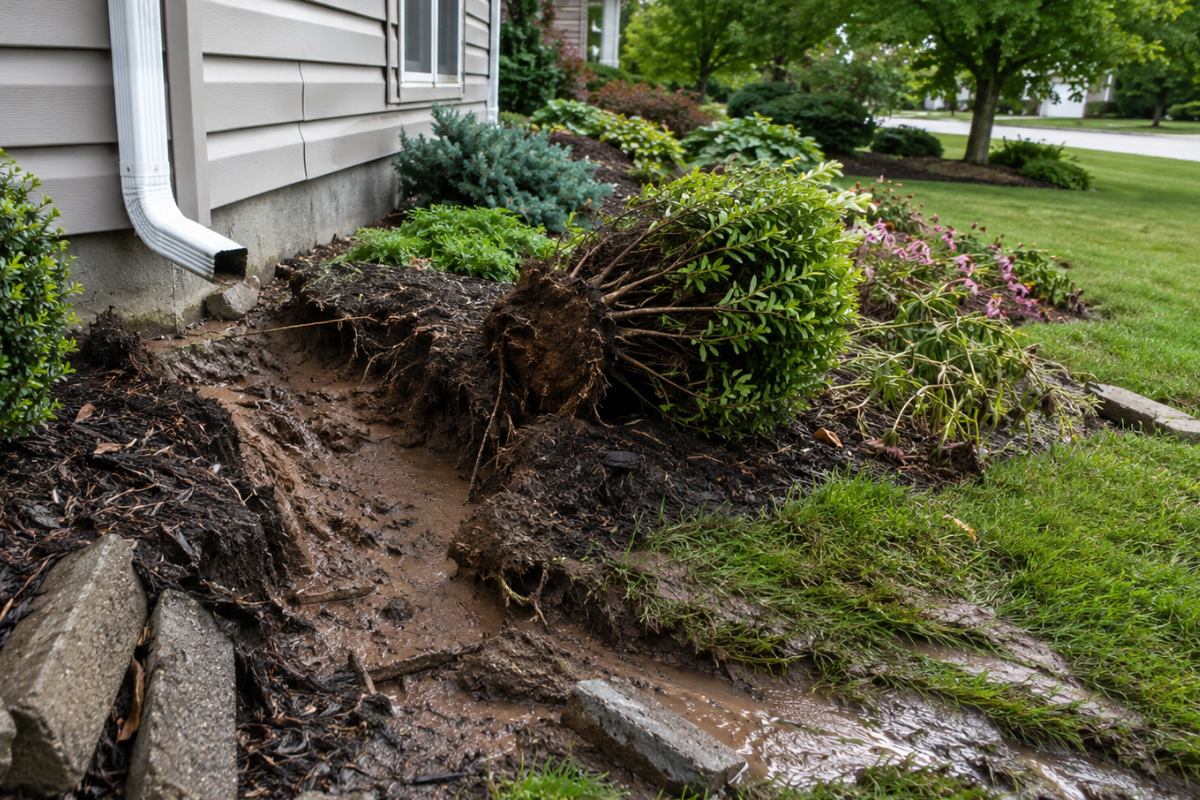
The second thing that happens when gutters pitch incorrectly is soil erosion, and this is where landscaping damage becomes both invisible and expensive.
When water repeatedly falls in one concentrated area, it can wash away mulch, compact the soil, and damage the landscaping beneath the gutter line.
Over time, that repeated overflow can create small erosion channels, strip away the topsoil, and expose the roots of established plants.
This is especially visible in sloped landscape areas where the erosion channel follows the grade of the property downhill.
Mature shrubs that took three to five years to establish can have their root zones destabilized within a single season of improper gutter drainage.
When roots become exposed, they lose the moisture and temperature protection provided by the surrounding soil, causing plants to weaken more quickly.
Replacing a mature, established shrub border around a commercial property costs significantly more than fixing the gutter installation that killed it.
Waterlogged Soil Creates Root Rot Conditions
Standing water in improperly pitched gutters does not stay in the gutter.
It seeps down the fascia board, travels behind the gutter mounting surface, and saturates the soil at the base of the exterior wall.
For properties with foundation plantings, such as boxwoods, junipers, ornamental grasses that zone directly against the structure, it becomes chronically wet.
Many foundation plants in Metro Atlanta cannot tolerate soil that stays wet for long periods.
When a flat gutter keeps dripping or overflowing into the same bed, the soil becomes waterlogged, roots lose oxygen, and the plants may begin to rot or decline.
The plant looks healthy above ground for weeks while the root system deteriorates.
By the time visible decline begins yellowing, wilting, leaf drop, the damage is already irreversible.
This is one of the most common landscape problems that homeowners and commercial property managers attribute to “disease” or “drought stress” when the actual cause is gutter pitch.
Downspout Overshoot Carves Trenches in Turf
Gutters pitched too steeply create a different but equally destructive problem.
Water accelerates through the channel and arrives at the downspout with more force and volume per second than the downspout system was sized to handle.
The excess shoots past the downspout opening, exits through the elbow at the bottom, and fires horizontally into whatever is at grade level, usually lawn, mulched beds, or hardscape.
The result is a visible trench cut into turf at the base of the downspout, erosion channels that follow the property grade from that point outward, and mulch displacement that requires constant replenishment.
For commercial properties where curb appeal is directly tied to customer and tenant perception, a trench cut through a maintained lawn line or a washed-out mulch bed at the building entrance is a visible signal of deferred maintenance even when the underlying cause is an installation error made by a contractor.
Why This Problem Is More Common Than Most Property Owners Realize
When you search for commercial gutter installation near me in Newnan, GA or look for the best gutter installation company for a property, the proposals you receive will all include pitch in the scope of work.
What they will not always tell you is how pitch will be verified during installation and who is accountable for correcting it if the system does not drain as designed after the first significant rain.
High-volume installation contractors working on a per-job pricing model have a financial incentive to move quickly.
Verifying pitch with a level on every run and making adjustments takes time.
On a commercial property with 400 linear feet of gutters, proper pitch verification can add 45 minutes to an hour to the installation time.
That time has to be paid for somewhere, and the contractor who wins on price alone is almost always the one who has shaved time from precision steps like this.
Eagle Watch Roofing’s commercial gutter installation process includes pitch verification at every run using a laser level, documented with notes on the work order.
If a run does not drain as specified within the first two rainfall events, we come back and correct it.
That accountability is what separates a best gutter installation company from a low-bid contractor, and it is what protects your landscaping investment.
Signs Your Current Gutters Are Pitched Incorrectly
You do not need to get on a ladder to identify pitch problems. Look for these visible indicators from ground level after any moderate rainfall:
Water dripping or sheeting over the front edge of a gutter mid-run rather than traveling to the downspout is the clearest indicator of insufficient pitch.
Muddy splash patterns in mulch beds directly below a gutter run, not at the downspout location, confirm overflow.
Persistent standing water in gutters visible from ground level 24 hours after rain indicates flat or reverse-pitched sections.
Erosion channels in turf or mulch that trace back to the base of a downspout suggest too-steep pitch causing overshoot.
When soil stays soft and wet along the foundation between downspouts, it may point to water escaping from a flat or poorly pitched gutter section.
Declining plants in the same area can be another sign of excess moisture.
Any one of these signs warrants a professional inspection. The longer improperly pitched gutters operate, the more accumulated landscaping damage compounds.
Conclusion
Wrong gutter pitch is one of the most under-diagnosed causes of landscaping loss on both residential and commercial properties.
The damage is slow enough that most property owners connect it to weather, disease, or routine wear rather than the installation error that is actually causing it.
By the time the pattern becomes clear, the landscaping investment often representing years of growth and thousands of dollars in plantings has already been compromised.
The most effective protection is proper installation from a gutter company that verifies pitch on every run, uses the right tools, and stands behind the result.
If you are searching for commercial gutter installation near me in Newnan, GA or evaluating the best gutter installation company for your property in the Metro Atlanta area, Eagle Watch Roofing provides free commercial and residential gutter inspections with written estimates and documented installation standards.
If your gutters are overflowing, holding water, or damaging the landscaping below, Eagle Watch Roofing can inspect the system and identify whether pitch, placement, or drainage design is the problem. Contact our team for trusted gutter service in Newnan, Metro Atlanta, and Coweta County.
Frequently Asked Questions
What is the correct gutter pitch for residential and commercial properties?
The industry standard is a quarter inch of slope for every ten linear feet of gutter run. This applies to both residential and commercial installations. For longer runs exceeding 40 feet, the run is typically split with downspouts at each end and a high point in the middle, allowing water to drain in both directions. Variations in this standard may be necessary based on roof geometry and drainage system design, which is why experienced gutter installation companies calculate pitch for each run individually rather than applying a single formula to the whole building.
Can wrong gutter pitch damage my foundation as well as my landscaping?
Yes, Wrong pitch damage to landscaping and foundation damage often occur simultaneously and from the same cause, such as water depositing in unintended locations rather than being channeled to designed drainage points. When water concentrates against the foundation line due to gutter overflow, the soil directly against the structure becomes chronically saturated, which over time can affect foundation stability. Addressing gutter pitch problems early prevents both the landscaping losses and the more serious and expensive foundation concerns from developing.
How do I know if the gutter installation company I’m hiring verifies pitch properly?
Ask the contractor directly: how do you verify pitch during installation, and what tool do you use to measure it? A qualified installer will describe using a level, chalk line, or laser level on each run and will be able to explain how they document it. Ask also what their process is if the system does not drain correctly after the first rain. A best gutter installation company will have a clear answer to both questions. If the contractor is vague or dismissive about pitch verification, which is a meaningful signal about their installation standards.
Does gutter pitch need to be re-verified after installation?
Yes, Gutter hangers can loosen over time, particularly on commercial properties where thermal expansion cycles are more significant due to larger roof and gutter surface areas. Sections that were correctly pitched at installation can develop low spots or reverse pitch as hanger hardware works loose. Eagle Watch recommends a gutter inspection every two to three years for commercial properties to verify that pitch and hanger integrity are maintained.
Is there a difference between residential and commercial gutter installation pitch requirements?
The pitch standard itself is the same, a quarter inch per ten feet, but commercial installations are more complex in execution. Commercial rooflines are longer, have more complex drainage patterns, and must handle higher water volumes during heavy rainfall events. Commercial gutter installation requires more downspout placement points, more precise pitch calculation across longer runs, and in many cases larger gutter profiles (6-inch or 7-inch) rather than the standard 5-inch residential profile. These differences make commercial gutter installation significantly more demanding technically than residential work.
What should I do if my landscaping has already been damaged by wrong-pitch gutters?
Start by having the gutters inspected and corrected before investing in landscape replacement. Installing new plants while the drainage problem persists guarantees the same outcome. Once the gutter system is properly installed and draining correctly, allow the soil to dry and re-establish its structure before replanting affected areas. Compacted soil in previously flooded beds benefits from aeration and organic matter addition before new plants go in. Eagle Watch Roofing provides free inspections for both residential and commercial properties across Newnan, Metro Atlanta, and Coweta County.