


Best Gutter Installation Company Trends to Follow in 2026
Gutter systems have changed significantly in recent years, and choosing the best gutter installation company can help homeowners benefit from updated materials, designs, and installation methods.
What was once viewed as a basic drainage feature now plays an important role in protecting the roof edge, siding, foundation, landscaping, and other areas around a property.
A properly planned system collects runoff from the roof and directs it toward suitable discharge points before it can collect near the home.
In 2026, gutter installation companies are using seamless construction, concealed fasteners, larger drainage components, durable finishes, and more accurate installation techniques.
These developments give homeowners more options for addressing leaks, overflow, frequent clogging, visible hardware, and premature gutter deterioration.
Understanding these trends can make it easier to get improvements that match the roof, drainage requirements, property layout, and available budget.
9 Gutter Installation Trends to Follow in 2026
Homeowners are increasingly looking for gutter systems that provide reliable water control while fitting naturally with the rest of the property.
For this reason, it is important to choose an experienced gutter installation company with knowledge of modern materials, roof drainage, fastening methods, and downspout placement.
The company should also stay current with emerging trends and adapt its installation approach to meet the changing needs of gutter systems in 2026.
The following trends highlight the materials, features, and installation techniques that may offer practical value for homeowners.
1. Seamless Gutter Systems
Seamless gutters are formed on-site from a continuous roll of material and cut to match the required length of each roof section.
Unlike sectional gutters, they do not require multiple pieces to be joined along a straight run.
Reducing the number of joints limits the areas where sections may separate or begin leaking. Seams are still necessary at corners, end caps, outlets, and certain transitions, so those areas must be sealed and maintained correctly.
The continuous construction also produces a more uniform finished system.
However, its performance still depends on accurate measurements, secure attachment, and correct positioning along the roof edge.
Hidden Gutter Hangers
Hidden hangers are replacing visible spikes and exterior brackets in many residential gutter installations.
These fasteners sit inside the gutter and connect the system to the fascia without leaving large pieces of hardware exposed.
In addition to providing a less noticeable fastening method, hidden hangers can distribute support along the gutter run when they are spaced appropriately.
This helps the system resist movement caused by water, debris, wind, or seasonal weather.
Spacing requirements may vary according to the gutter material, fascia condition, roof layout, and expected loads.
Hangers placed too far apart may allow the gutter to sag or pull away over time.
Higher-Capacity Gutters and Downspouts
Larger gutters and downspouts are becoming more common on homes with steep roofs, wide roof surfaces, complex valleys, or areas where several roof sections drain toward one location.
A higher-capacity system can move more runoff during heavy rain, but larger components alone will not correct every drainage problem.
Water may still overflow when the gutter pitch is incorrect, outlets are poorly positioned, or downspouts are blocked.
The entire drainage path should be considered, including roof area, slope, gutter size, outlet quantity, downspout route, and discharge location.
If water continues collecting near the home, grading, underground drains, soil conditions, or stormwater systems may also need evaluation.
Durable Aluminum Gutter Systems
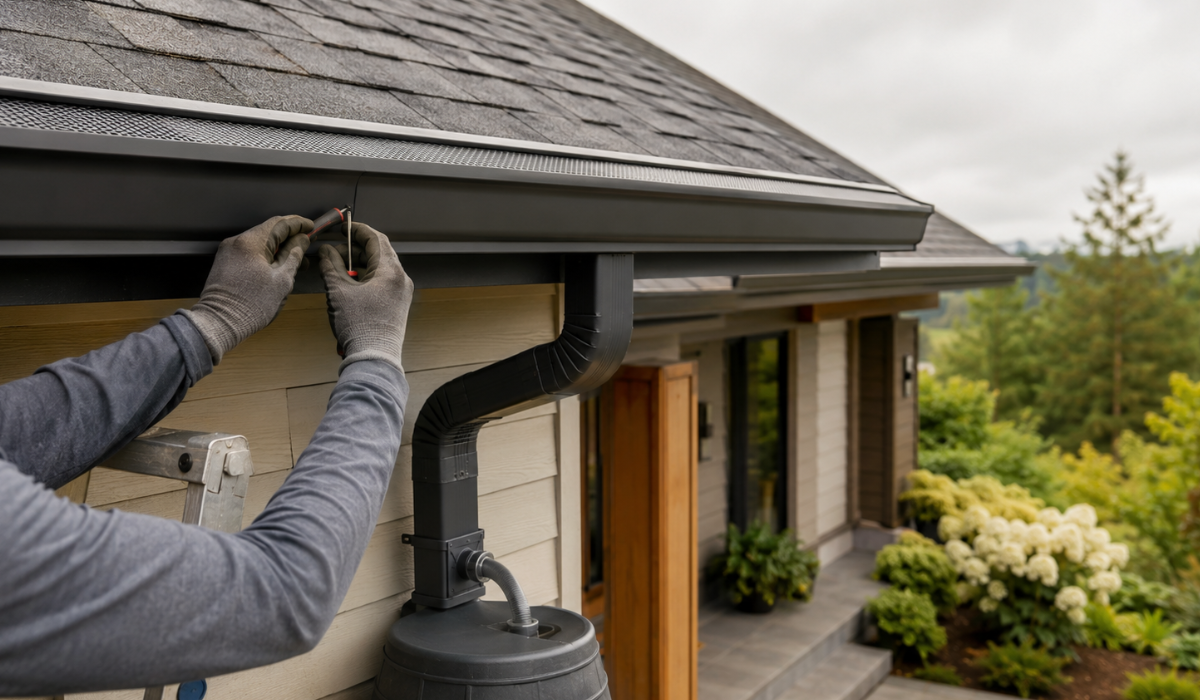
Aluminum remains one of the most widely used gutter materials because it is lightweight, corrosion-resistant, and suitable for seamless fabrication.
It is available in several profiles, sizes, thicknesses, and factory-applied finishes. This gives homeowners flexibility when selecting a system for different roof designs and budgets.
Although aluminum does not rust like some metals, it can dent or bend when struck by branches, ladders, or heavy debris.
Choosing an appropriate material thickness and securing the system correctly can improve its resistance to everyday damage.
Copper and Other Premium Metals
Copper gutters are often selected for properties where the drainage system is intended to become an architectural feature.
New copper has a bright metallic finish that gradually develops a natural patina through outdoor exposure.
The material can provide a long service life, but it generally costs more than aluminum and may require specialized joining, fastening, and installation techniques.
Steel may be considered where additional strength is a priority, while zinc offers another distinctive metal option for certain architectural styles.
Homeowners should compare initial cost, weight, maintenance, appearance, and compatibility with surrounding materials before choosing a premium system.
Gutter Guards and Debris-Control Systems
Gutter guards are becoming a common addition for properties surrounded by trees or exposed to frequent leaf and debris accumulation.
Screens, covers, filters, and surface-tension systems are designed to reduce the amount of material entering the gutter channel.
Limiting debris may help prevent blockages and reduce how often the gutters require cleaning.
However, no gutter guard makes a system completely maintenance-free.
Small particles, roof granules, seeds, and organic material may still collect around openings, valleys, corners, or downspout outlets.
Periodic inspections remain necessary to confirm that water is entering and leaving the system properly.
Coordinated Gutter Colors and Finishes
Homeowners now have more gutter color and finish options than basic white or unfinished metal.
Black, bronze, charcoal, beige, and other neutral finishes can be selected to match the fascia, roof, siding, windows, or trim.
Some homeowners prefer a subtle match, while others use contrasting gutters to emphasize the shape of the building.
Matte and textured finishes are also gaining attention because they may reduce glare and create a more understated appearance.
Color selection should account for the full exterior rather than being based on the gutter alone.
Rainwater Collection and Sustainable Materials
Some homeowners are connecting gutter systems to rain barrels, storage tanks, or landscape irrigation features as part of a broader water-management plan.
These systems collect runoff for approved outdoor uses, such as watering certain plants or landscaped areas.
The collection method must include suitable screening, overflow control, and discharge planning so excess water does not return toward the building.
Recycled aluminum and other long-lasting materials are also being considered by homeowners who want to reduce replacement frequency.
Sustainability should be evaluated alongside durability, maintenance requirements, local rules, and the property’s actual drainage needs.
More Accurate Installation Techniques
Improved installation practices are among the most valuable gutter trends in 2026.
Even a high-quality system may perform poorly when it is measured incorrectly or installed on damaged supporting materials.
Installers must create an appropriate gutter pitch, use secure fastening points, position outlets strategically, and direct downspouts toward suitable drainage areas.
The fascia should also be checked for deterioration before a new system is attached.
Greater attention to measurements and water-flow patterns can help prevent standing water, loose sections, repeated leaks, and runoff near the foundation.
This makes installation quality just as important as the material or style selected.
How to Choose the Right Gutter Trends for Your Home
Not every new gutter feature is necessary for every property. Homeowners should begin by identifying the specific problem they need to solve.
A property with frequent overflow may need a capacity and drainage evaluation.
A home surrounded by trees may benefit from a suitable debris-control system. Damaged or sagging sections may point to fastening problems, deteriorated fascia, or an incorrect gutter pitch.
The roof size, roof slope, rainfall exposure, surrounding trees, exterior materials, existing drainage, and budget should all influence the final decision.
Trends provide useful options, but the selected upgrades should address the conditions of the property rather than being added only because they are popular.
A knowledgeable gutter contractor can inspect these factors and explain which features are likely to provide meaningful benefits.
Homeowners should receive clear information about the recommended material, size, hanger placement, downspout route, maintenance needs, and expected limitations of the system.
Conclusion
A gutter trend is only valuable when it solves a real problem and fits the needs of the property.
Property owners should look beyond what is popular and consider whether an upgrade will improve drainage, reduce ongoing issues, or make the system easier to maintain.
Eagle Watch Roofing helps Newnan residents assess the condition of their gutters, fascia, roof edges, and drainage areas. Based on the findings, they can better understand whether leaking gutter repair, a targeted upgrade, or full replacement is the right next step.
Those planning a gutter installation can schedule an evaluation with our team and learn which options may be most suitable for their property
FAQs
What are the common problems with seamless gutters?
Seamless gutters can leak at corners, end caps, outlets, and downspout connections if those areas become loose or damaged. Incorrect pitch, poor fastening, clogs, and undersized components may also cause sagging or overflow.
What is the latest gutter design?
Current gutter designs often use seamless construction, internal hangers, coordinated finishes, and larger drainage components. The most suitable design depends on the roof layout, expected runoff, surrounding debris, and architectural style.
How are seamless gutters put together?
Seamless gutters are formed on-site from a continuous roll of metal and cut according to the roof measurements. Installers then add end caps, outlets, corners, hangers, and downspouts to complete the drainage system.
What are common gutter installation mistakes?
Common mistakes include using the wrong size, creating an incorrect slope, placing hangers too far apart, and directing downspouts toward the foundation. Installing gutters over damaged fascia can also lead to loose or unstable sections.
How long do seamless gutters last?
The lifespan of seamless gutters depends on the material, thickness, weather exposure, installation quality, and maintenance. Prompt repairs and routine cleaning can help prevent minor damage from becoming a larger system failure.