
A Complete Guide to Commercial Roofing Services in Newnan, GA
A commercial roof protects more than a building.
It helps protect inventory, equipment, employees, tenants, customers, and daily business operations.
For this reason, choosing commercial roofing services in Newnan, GA, requires more than comparing materials and prices.
Business and property owners must consider the roof’s condition, building use, drainage, insulation, project schedule, applicable codes, and future maintenance needs.
They also need a contractor with experience managing commercial-scale projects while reducing avoidable disruption.
What Are Commercial Roofing Services?
Commercial roofing services cover the inspection, installation, repair, replacement, and maintenance of roofs on business and income-producing properties.
Depending on the roof’s condition, these services may include:
- Commercial roof inspections
- Leak detection and localized repairs
- Preventive roof maintenance
- Storm-damage assessments
- Roof coatings or restoration, when appropriate
- Partial or complete roof replacement
- New commercial roofing installation
An inspection helps determine which service is suitable.
A small membrane puncture may only require repair, while widespread moisture or repeated leaks may indicate the need for more extensive work.
How Is Commercial Roofing Different From Residential Roofing?
Commercial roofing projects often involve larger surfaces, low-slope designs, internal drainage, rooftop HVAC units, vents, and other penetrations.
They may also require specialized materials and installation methods.
The buying process is different as well.
A commercial project may involve owners, property managers, tenants, maintenance staff, insurance representatives, and financial decision-makers.
Before approving the work, these parties may need to review budgets, insurance documents, safety procedures, warranties, schedules, and written proposals.
Residential roofing experience alone does not demonstrate that a contractor is prepared to manage these requirements.
Property owners should look for experience with comparable commercial roofing systems, building types, and project conditions.
Signs a Commercial Roof Needs Attention
Commercial roof damage is not always visible from inside the building.
However, several warning signs may indicate that an inspection is needed:
- Active leaks or ceiling stains
- Ponding or slow-draining water
- Loose or damaged flashing
- Open seams, cracks, splits, or punctures
- Blistering or bubbling in the membrane
- Loose fasteners
- Rusted or damaged metal panels
- Wet or deteriorated insulation
- Damage following heavy rain, hail, or high winds
These signs do not automatically mean that the entire roof needs replacement.
A commercial roof inspection can help identify the source, location, and extent of the problem.
Does the Roof Need Repair, Restoration, or Replacement?
The correct option depends on the condition of the roof and the owner’s plans for the property.
Commercial Roof Repair
Commercial roof repair may be suitable when damage is limited to a particular area.
Examples include a punctured membrane, damaged flashing, an open seam, or a leak around rooftop equipment.
A repair should address the cause of the problem rather than simply covering the visible damage.
Commercial Roof Restoration
A restoration system or roof coating may be considered when the existing roof is still structurally suitable.
Restoration may help address surface wear and improve protection without removing the complete roofing system.
Not every roof qualifies.
Moisture within the assembly, deck damage, poor drainage, or incompatible materials may make restoration unsuitable.
Commercial Roof Replacement
Commercial roof replacement may be recommended when deterioration is widespread, leaks continue to return, insulation is wet, or the roof is near the end of its practical service life.
The decision should be based on an inspection and a comparison of short-term repair costs with the potential value of a new system.
Common Commercial Roofing Systems
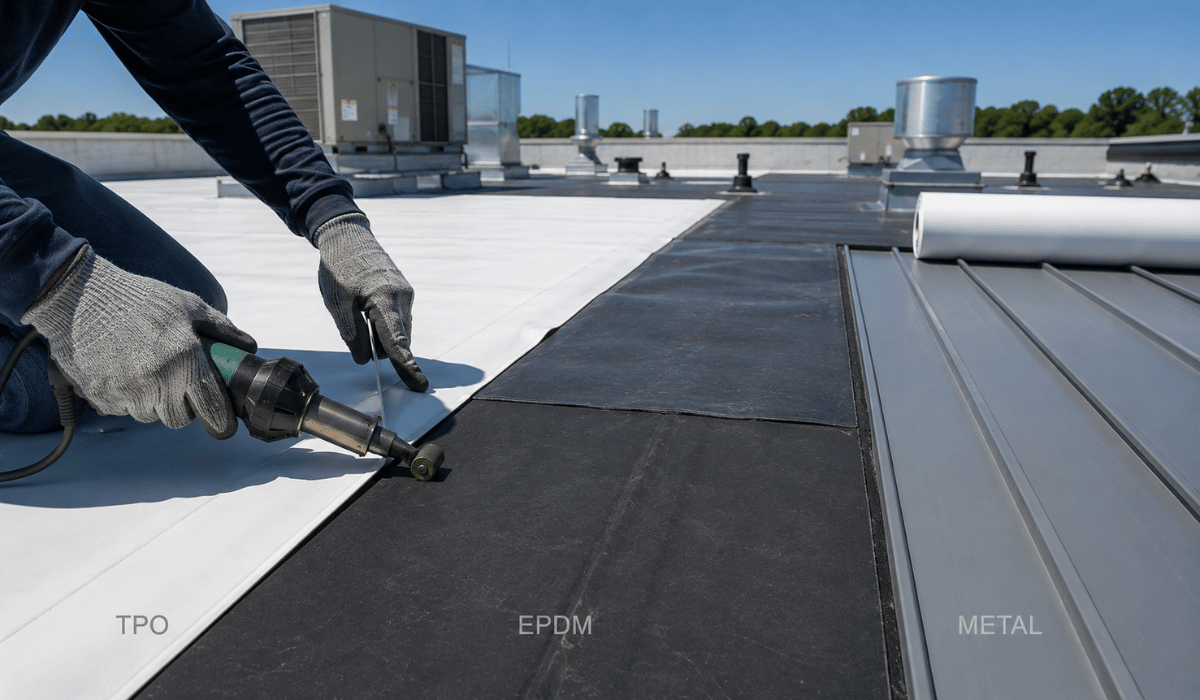
Commercial roofs are available in several materials and assemblies.
The right choice depends on the roof’s slope, structure, drainage, building use, budget, and maintenance requirements.
TPO Roofing
Thermoplastic polyolefin, or TPO, is a single-ply membrane commonly installed on low-slope roofs.
Its seams are joined with heat-welding equipment, and reflective product options are available.
Membrane thickness, attachment method, drainage, foot traffic, and installation quality can affect its performance.
EPDM Roofing
EPDM is a synthetic rubber membrane used on many low-slope commercial buildings.
It can be installed using different attachment methods and is known for remaining flexible under changing temperatures.
Seam design, membrane thickness, rooftop traffic, and maintenance should be considered when evaluating this option.
PVC Roofing
PVC is another single-ply roofing membrane with heat-welded seams.
Certain PVC systems may be suitable for buildings where the roof is exposed to grease, oils, or specific chemicals.
Suitability must be confirmed using manufacturer specifications.
Modified Bitumen Roofing
Modified bitumen is an asphalt-based roofing material reinforced for added strength.
Depending on the product, it may be installed with adhesives, self-adhered sheets, hot asphalt, or other approved methods.
Built-Up Roofing
Built-up roofing uses several layers of reinforcing material and asphalt.
Deck condition, drainage, structural capacity, and the installation method all influence whether this system is appropriate.
Commercial Metal Roofing
Metal roofing may be used on low-slope or steep-slope commercial buildings.
Standing-seam systems use raised seams and concealed fasteners.
Panel design, protective coatings, flashing, expansion, and installation quality influence long-term performance.
There is no single roofing material that works best for every commercial property.
The building and its operating conditions should guide the selection.
What Affects Commercial Roofing Installation Costs?
The price of commercial roofing installation depends on more than the building’s square footage.
Important cost factors include:
- Existing roof condition
- Tear-off and disposal requirements
- Wet insulation or damaged decking
- Roofing material and product specifications
- Roof height and accessibility
- Rooftop equipment and penetrations
- Drainage or insulation improvements
- Required permits and inspections
- Equipment and material staging
- Installation schedule
- Warranty options
A low bid may exclude work included in another contractor’s proposal.
Property owners should compare materials, specifications, allowances, exclusions, warranties, and responsibilities before choosing a local roof installation service.
How Can Disruption to Business Operations Be Reduced?
Commercial roofing work may create noise, dust, odors, blocked access, or changes to normal traffic patterns.
Although disruption cannot always be eliminated, careful planning can help manage it.
The contractor and property representative should discuss:
- Work phases and expected schedules
- Material and equipment staging
- Customer and employee entrances
- Pedestrian and vehicle routes
- Deliveries and busy operating periods
- Protection around rooftop equipment
- Weather-related schedule changes
- Communication with tenants or building occupants
- Contingency plans for unexpected conditions
A clear point of contact can help ensure that schedule updates and safety information reach the appropriate people.
Why Do Codes, Permits, and Safety Planning Matter?
A commercial roofing project may be affected by building, energy, fire, drainage, and wind-related requirements.
Manufacturer installation instructions may also determine which materials and methods qualify for a particular system or warranty.
Workplace-safety requirements, including applicable OSHA rules, are separate from building-code requirements.
A contractor should be prepared to explain how safety, permits, inspections, and manufacturer specifications will be addressed.
Exact requirements depend on the building, location, project scope, and codes currently in effect.
They should be verified before work begins.
What Should a Commercial Roofing Proposal Include?
A detailed proposal helps owners compare more than the final price.
It should clearly identify:
- Existing roof conditions
- Recommended work and materials
- Tear-off or overlay details
- Insulation and deck-repair allowances
- Flashing, drainage, and penetration work
- Project schedule and staging plan
- Cleanup and disposal
- Permit responsibilities
- Payment and change-order terms
- Workmanship coverage
- Available manufacturer warranties
- Exclusions and owner responsibilities
Ask for clarification when a proposal uses broad wording or leaves important work undefined.
Choosing a Commercial Roofing Contractor in Newnan
Before hiring a commercial roofing contractor in Newnan, ask about experience with similar roofing systems and properties.
Request proof of liability insurance and workers’ compensation coverage, along with relevant project examples or references.
The contractor should explain who will manage the project, how occupants will be protected, what may interrupt normal operations, and how unexpected damage will be handled.
Manufacturer certifications can be helpful, but they should be considered along with experience, communication, written warranty terms, and the proposed scope.
Eagle Watch Roofing can evaluate the property and discuss commercial roofing options based on the roof’s condition, the building’s needs, and the planned budget.
Why Is Commercial Roof Maintenance Important?
Regular commercial roof maintenance and inspections can identify loose flashing, blocked drains, open seams, punctures, and developing leaks before they affect larger areas.
Maintenance may also help protect insulation and decking, preserve drainage paths, support applicable warranty conditions, and help the roof reach more of its expected service life.
Inspections may be especially useful after severe storms or work involving rooftop equipment.
FAQs
What type of roofing is commonly used on commercial buildings?
TPO, EPDM, PVC, modified bitumen, built-up roofing, and metal are common options. The appropriate system depends on the roof slope, drainage, building use, existing assembly, and budget.
How long does commercial roofing installation take?
The timeline depends on roof size, material, access, weather, tear-off requirements, and repairs discovered during the project. The contractor should provide an estimated schedule after inspecting the property.
Can a commercial roof be repaired instead of replaced?
Yes, localized damage may be repairable when the surrounding roof remains in suitable condition. Widespread deterioration, trapped moisture, or recurring leaks may require restoration or replacement.
Can a business remain open during roof installation?
Some businesses can continue operating with proper planning, but this depends on access, noise, odors, safety requirements, and the project scope. Phased work and clear communication may help reduce disruption.
How often should a commercial roof be inspected?
The appropriate schedule depends on the roofing system, building conditions, manufacturer guidance, and warranty requirements. An additional inspection may be advisable after a major storm or rooftop work.
What should be included in a commercial roofing estimate?
The estimate should explain the scope, materials, installation method, repairs, schedule, cleanup, payment terms, exclusions, and warranty options. Detailed information makes competing proposals easier to compare.