


Commercial Gutter Installation for Newnan Properties: Sizing, Drainage, and Building Protection
When a gutter system does not direct water away from a commercial building efficiently, the consequences go far beyond a wet sidewalk.
Damaged fascia boards, foundation erosion, interior leaks, and long-term structural deterioration can cost a property owner many times what a properly designed gutter system would have.
For commercial buildings in Newnan, GA, from retail centers and office parks to warehouses, churches, and multifamily complexes, the right gutter system is a critical piece of building infrastructure.
This guide helps commercial property owners and facility managers understand gutter sizing, material options, drainage design, and the difference between commercial and residential installation.
Why Commercial Gutter Installation Matters for Newnan Properties
Newnan, GA experiences a humid subtropical climate with significant annual rainfall often exceeding 50 inches per year.
Commercial buildings face more drainage challenges than single-family homes. Larger footprints, low-pitch roofs, and busy entrances increase the need for proper water management.
Protecting Roof Edges, Fascia, and Exterior Walls
Water that overflows or backs up behind a gutter does not simply evaporate.
It saturates fascia boards, penetrates behind siding, and can work its way under roof underlayment.
On commercial buildings, where rooflines may span hundreds of linear feet, even a slight gutter failure can expose large surface areas to moisture intrusion.
Replacing rotted fascia on a warehouse or retail strip is significantly more expensive than maintaining the gutters that protect it.
Preventing Water Pooling Around Foundations and Walkways
Commercial properties depend on safe, well-maintained entries and parking areas.
Improperly drained water collects near foundations and walkways. It can create slip hazards, damage concrete, and increase pressure on foundation walls.
Over time, this kind of standing water can compromise the structural integrity of the building itself.
Reducing Long-Term Maintenance Problems for Business Properties
A well-designed gutter system is a long-term investment in reduced maintenance costs.
Key Point: Commercial buildings collect far more water per rain event than residential properties. Every aspect of the gutter system, such as size, pitch, material, hanger spacing, and downspout placement must be scaled accordingly.
How Commercial Gutters Are Different from Residential Gutters
Property managers who assume a commercial gutter installation is simply a larger version of a residential one often end up with undersized, underperforming systems. The differences go beyond scale.
Larger Roof Areas Require Higher Water Capacity
A standard residential home may have 1,500 to 2,500 square feet of roof area draining into gutters sized at 5 inches.
A commercial building, a church, office complex, or warehouse may have 10,000 to 100,000 square feet of roof area.
The volume of water that must be handled during a heavy storm event is exponentially greater.
Commercial gutters often start at 6 inches and may require 7-inch, 8-inch, or box gutter configurations depending on the building.
Commercial Gutters Often Need Stronger Attachment Systems
Residential gutters are commonly secured with spike-and-ferrule fasteners.
This method degrades over time as wood fascia boards expand and contract seasonally, gradually loosening the attachment.
Commercial installations should use screws and hidden hanger systems rated for heavier loads.
On large buildings, the sheer weight of water-filled gutters during a rain event creates significant stress on the attachment points.
Hanger spacing on commercial-grade installations is typically tighter often every 24 to 32 inches to prevent sagging under load.
Downspout Placement Is More Important on Commercial Buildings
On a residential property, a downspout every 30 to 40 feet may be sufficient.
On a commercial building with long gutter runs and large drainage areas, downspout frequency, placement, and size must be calculated based on rainfall intensity, roof slope, and the total square footage draining to each outlet.
Undersized or improperly spaced downspouts are among the leading causes of gutter overflow on commercial properties.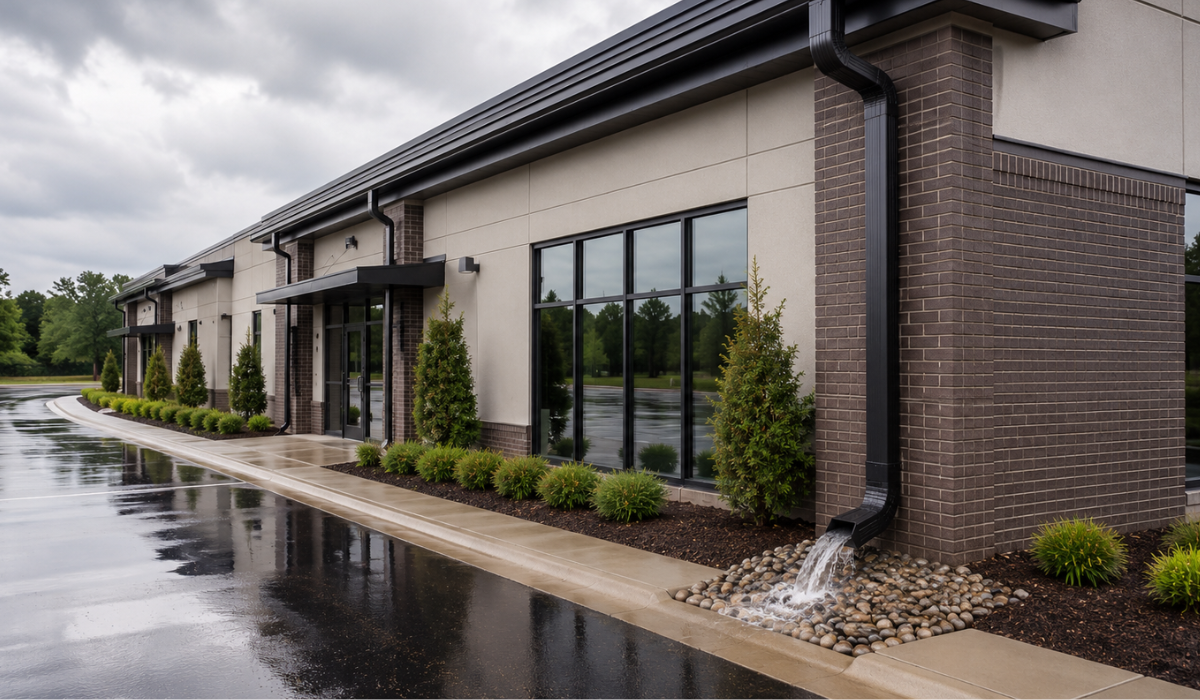
Commercial Gutter Sizing: What Property Owners Should Know
Gutter sizing is not a matter of preference, it is an engineering calculation based on the roof’s drainage area, pitch, local rainfall intensity, and the number of downspouts.
The following guidance applies to commercial properties in the Newnan, GA market.
When 6-Inch Gutters May Be Needed
Buildings with moderate roof spans, steeper pitches, or medium-size drainage areas are often well-served by 6-inch K-style gutters.
The step up from a standard 5-inch to a 6-inch gutter increases drainage capacity substantially, the wider profile allows for greater water volume before overflow occurs.
For commercial buildings with multiple drainage zones, a correctly installed 6-inch system with appropriate downspout sizing may be entirely adequate.
When Box Gutters or Larger Systems Make Sense
Flat-roof commercial buildings, older structures with built-in gutters, and properties with very large roof areas are candidates for box gutter systems.
Box gutters are rectangular channels often 7 inches wide or larger that are integrated into the roofline rather than attached to the fascia.
They are designed to handle significantly higher water volumes and are particularly common on industrial facilities, churches with wide nave roofs, and commercial buildings with parapet walls.
As compared to K-style gutters, box gutters are typically fabricated on-site or ordered to specific dimensions.
Why Roof Pitch and Rainfall Volume Affect Gutter Size
A steeper roof pitch increases the speed at which water reaches the gutter, which raises the drainage load even when the roof area is not extremely large.
A flat or low-slope commercial roof may deliver water more slowly, but it often sends larger, more sustained volumes into the gutter system.
Newnan’s rainfall patterns, including intense summer thunderstorms, mean commercial gutter systems should be designed for peak rainfall intensity, not just average conditions.
A gutter system that works in light rain but overflows during a heavy storm is not adequate for a commercial property.
5-inch K-style gutters work for small commercial offices with moderate drainage needs.
6-inch K-style gutters are common for retail buildings, mid-size offices, churches, and most standard commercial properties.
7-inch K-style gutters are better for larger commercial buildings, warehouses, and long roofline runs.
Box gutters 7 inches or larger are used for industrial, flat-roof, or institutional buildings that need very high drainage capacity.
Best Gutter Options for Commercial Buildings
Material selection for commercial gutters should be driven by drainage requirements, building aesthetics, maintenance expectations, and budget.
Each option offers a different balance of performance and cost.
Seamless Aluminum Gutters
Seamless aluminum gutters are the most common choice for commercial buildings.
Fabricated on-site to run the full length of a roof section without joints, they eliminate the seam failures that cause most gutter leaks.
Aluminum does not rust, is available in a wide range of colors, and can be fabricated at 6-inch or 7-inch widths for higher-volume applications.
For most Newnan commercial properties, such as retail buildings, offices, multifamily seamless aluminum represents the best combination of performance, longevity, and cost.
Box Gutters
Box gutters are the heavy-duty option for commercial applications.
Their rectangular profile and larger dimensions allow them to handle the water output of very large or flat roof sections.
They are often used on warehouse facilities, churches with wide-span roofs, and institutional buildings.
Box gutters can be fabricated from aluminum, galvanized steel, or copper, and are typically integrated into the roofline structure rather than surface-mounted.
Proper installation requires precise pitch calculation to prevent standing water, which accelerates corrosion.
Steel or Heavy-Duty Gutter Systems
Galvanized or Galvalume steel gutters offer superior strength and impact resistance compared to aluminum.
They are a better choice for facilities where physical damage is a concern loading dock areas, industrial buildings, or properties in high-wind zones.
Steel gutters are heavier, require corrosion-resistant coating maintenance, and cost more than aluminum, but they offer a longer service life under demanding conditions.
Copper Gutters for Appearance-Focused Properties
Copper gutters are selected for commercial properties where architectural appearance is a primary concern, which includes historic buildings, upscale retail centers, and institutional facades.
Copper develops a natural patina over time and can last 50 to 100 years with minimal maintenance.
The cost of copper is significantly higher than aluminum or steel, making it appropriate for projects where aesthetic value and longevity justify the investment.
Should Commercial Buildings Add Gutter Guards?
Gutter guards, debris protection systems that cover or filter the gutter opening are frequently considered for commercial buildings near trees, with large roof areas, or in situations where maintenance access is difficult or costly.
When Gutter Guards Help Reduce Maintenance
For commercial properties where gutter cleaning requires lift equipment, roof access permits, or presents safety challenges, gutter guards can meaningfully reduce the frequency of required maintenance.
Properties near mature trees, in areas with significant seed or pod fall, or with gutters on upper stories are good candidates for debris protection.
By reducing blockage frequency, guards help ensure the gutter system performs as designed through Newnan’s spring and fall storm seasons.
When Debris Protection Is Most Useful
Buildings that have experienced repeated gutter blockages leading to overflow events should evaluate whether a gutter guard system can address the root cause.
On commercial buildings where overflow occurs regularly at the same downspout locations, guards may be part of a broader solution that also includes downspout upsizing and improved drainage design.
Why Gutter Guards Still Need Proper Installation
Gutter guards do not eliminate maintenance entirely.
Fine debris, pine pollen, shingle granules, and small particles can accumulate on the guard surface and restrict flow over time.
More importantly, gutter guards installed on an undersized or improperly pitched gutter system will not resolve overflow problems.
Guards should be selected to match the specific gutter profile and installed by a contractor familiar with commercial drainage requirements.
IMPORTANT
Gutter guards reduce maintenance frequency but do not replace the need for periodic inspection and cleaning on commercial properties. Annual or biannual professional inspection is still recommended.
Signs Your Commercial Gutters Need Replacement
Many commercial property owners delay gutter replacement until visible damage appears.
In most cases, warning signs appear months before failure. Replacement usually costs less than repairing water damage after a gutter system fails.
Overflow During Heavy Rain
If water spills over the front or back of the gutter during moderate-to-heavy rain rather than moving cleanly to the downspouts, the system is either blocked, undersized, or improperly pitched.
On a commercial building, overflow near entrances creates immediate liability and safety concerns. Overflow at the roofline contributes to fascia and exterior wall damage.
Sagging or Pulling Away from the Building
Gutters that sag visibly or have separated from the fascia are no longer draining at the correct pitch and are placing stress on the attachment points.
This is particularly common in older commercial buildings where spike-and-ferrule fasteners have worked loose over years of thermal expansion.
Sagging gutters hold standing water, which accelerates corrosion and adds weight load and will eventually fail at the attachment points.
Rust, Leaks, or Separated Seams
Section gutters as opposed to seamless systems have joints every 10 feet or so.
These joints are a chronic maintenance issue as sealant degrades over time.
Separated or leaking seams often show that the building needs a seamless gutter replacement. In many cases, replacement costs less over time than repeated repairs.
Water Stains, Soil Erosion, or Foundation Pooling
Staining on exterior walls below the gutter line indicates chronic overflow or drip-through.
Soil erosion at the building perimeter and standing water near the foundation are downstream indicators of a failing gutter system.
These signs may appear well before the gutters themselves show obvious damage, making visual inspection of the landscape around a building a useful diagnostic tool.
How Eagle Watch Roofing Helps with Commercial Gutter Installation in Newnan
Local Gutter and Roofing Knowledge
Eagle Watch Roofing works with commercial property owners throughout Newnan, GA and the surrounding area.
Our team understands the local rainfall patterns, building stock, and code requirements that affect commercial gutter design in this market.
We do not apply residential installation practices to commercial projects.
Commercial Drainage-Focused Recommendations
Before recommending a gutter system, we assess the building’s roof area, slope, drainage zones, existing downspout locations, and the specific water management challenges the property faces.
We size gutters and downspouts based on actual load calculations, not rule-of-thumb estimates.
Our commercial installations use screw-and-hanger attachment systems with appropriate spacing for the gutter size and building type.
Support for Roof Repair, Gutter Replacement, and Water Damage Prevention
Gutter replacement often uncovers underlying issues such as fascia rot, deteriorated roof edge flashing, or improperly sloped rooflines.
Eagle Watch Roofing can identify and address these related problems during the gutter installation process, reducing the likelihood of callbacks and protecting your building from the water damage that underperforming drainage systems cause.
Conclusion
Commercial gutter installation for Newnan properties is not a commodity service. It is a technical decision that affects building longevity, maintenance costs, occupant safety, and long-term property value.
The right system begins with a proper drainage assessment. A contractor should calculate roof area, account for pitch and rainfall volume, select the right gutter profile, and plan downspout placement for peak-load conditions.
Property owners who invest in a correctly designed and professionally installed commercial gutter system protect their buildings from the fascia deterioration, foundation erosion, exterior wall damage, and interior leaks that follow inadequate drainage.
Contact Eagle Watch Roofing for commercial gutter installation in Newnan, GA. Our team can inspect your property, review drainage concerns, and recommend a gutter system designed to protect your building size correctly, installed properly, and built for the long term.
Call us today or visit eaglewatchroofing.com to schedule a commercial property assessment.
Frequently Asked Questions
What size gutters are best for commercial buildings?
Commercial buildings typically require gutters larger than the 5-inch standard used in residential construction. For most commercial applications in Newnan, 6-inch K-style gutters are appropriate for mid-size buildings, while larger structures with flat roofs, wide spans, or high drainage loads may require 7-inch, 8-inch, or box gutter systems. The correct size is determined by calculating the effective drainage area, roof slope, and local rainfall intensity — not by building square footage alone.
What is the difference between commercial and residential gutters?
Commercial gutters are typically larger in profile (6 to 8 inches vs. 5 inches), fabricated in longer seamless runs, attached with heavier-duty hanger systems, and designed to handle significantly higher water volumes from larger roof areas. Residential gutters are optimized for single-family homes with smaller drainage areas. Applying residential gutter specifications to a commercial building results in chronic overflow, accelerated wear, and potential water damage.
Are box gutters better for commercial properties?
Box gutters are the appropriate choice for specific commercial building types — flat-roof facilities, industrial structures, churches with wide nave roofs, and properties with built-in gutter channels. They handle larger water volumes than K-style gutters and integrate cleanly into certain building designs. However, they require precise pitch installation to prevent standing water and are typically more expensive to install and maintain than standard commercial K-style systems.
How do I know if my commercial gutters are too small?
Overflow during moderate-to-heavy rain, water cascading near building entrances, persistent staining on exterior walls below the gutter line, and foundation pooling are all indicators of an undersized or poorly designed gutter system. Buildings that required frequent gutter cleaning despite no obvious debris accumulation may also have undersized downspouts that are regularly overwhelmed by drainage volume.
How much does commercial gutter installation cost?
Commercial gutter installation costs vary significantly based on building size, gutter material, system type (seamless vs. sectional, K-style vs. box), and project complexity. For reference, a standard gutter installation for 200 linear feet may range from $1,000 to $5,600. Larger commercial projects with specialized systems, significant run lengths, or complex rooflines will fall outside this range. Eagle Watch Roofing provides detailed project-specific estimates after assessing the building.
Should commercial buildings add gutter guards?
Gutter guards can meaningfully reduce maintenance frequency on commercial buildings near trees, with difficult-to-access gutters, or with a history of debris blockage. They should be matched to the specific gutter profile and installed correctly. Guards do not eliminate the need for periodic inspection and will not resolve overflow problems caused by an undersized system.
Can bad gutters damage a commercial roof?
Yes, when gutters overflow, back up, or pull away from the fascia, water can infiltrate the roof edge, fascia boards, soffit, and exterior wall assembly. Over time this leads to wood rot, mold, and in severe cases structural degradation. On commercial buildings, where large roof sections may drain into a limited number of gutter runs, a single failing segment can expose significant surface area to moisture intrusion.
How often should commercial gutters be inspected?
Commercial gutters should be professionally inspected at minimum twice per year — ideally before and after Newnan’s peak storm season. Buildings with large tree coverage, flat roofs, older sectioned gutter systems, or a prior history of water damage should be inspected more frequently. After any major storm event, a visual inspection of downspout flow and gutter condition is advisable.