


Commercial Gutter Installation for Flooding in Newnan, GA
Standing water around a commercial driveway, patio, entrance, or walkway can interfere with access and make exterior areas more difficult to maintain.
Although several drainage conditions can contribute to flooding, uncontrolled roof runoff is often one possible source.
Commercial gutter installation in Newnan, GA can help collect water from the roof and direct it toward an appropriate discharge area.
However, gutters are only one part of a complete drainage system. Property grading, pavement slope, ground saturation, storm drains, catch basins, and underground drainage may also need to be evaluated.
The goal of a commercial gutter system is not to guarantee that flooding will disappear.
It is to manage roof runoff more effectively and prevent it from being released directly onto vulnerable exterior areas.
Can Commercial Gutters Reduce Flooding?
Commercial gutters may reduce flooding when a significant amount of water is coming from the roof.
Without an effective gutter system, rainwater may flow over the roof edge and land beside the building.
It can then move across concrete, collect near entrances, wash through landscaping, or follow the slope of the property toward low areas.
Gutters provide a controlled route for this water. They collect runoff at the roofline and carry it through downspouts to a planned discharge point.
However, installing gutters may not correct flooding caused by:
- Improper property grading
- Pavement that slopes toward the building
- Blocked storm drains or catch basins
- Poor soil infiltration
- Damaged underground drainage pipes
- Runoff entering from nearby properties
- Low areas that naturally collect water
The EPA explains that rooftops, parking lots, driveways, sidewalks, and other impervious surfaces reduce water infiltration and increase surface runoff.
This means a commercial property may need several drainage measures working together rather than relying on gutters alone.
How Roof Runoff Reaches Driveways and Patios
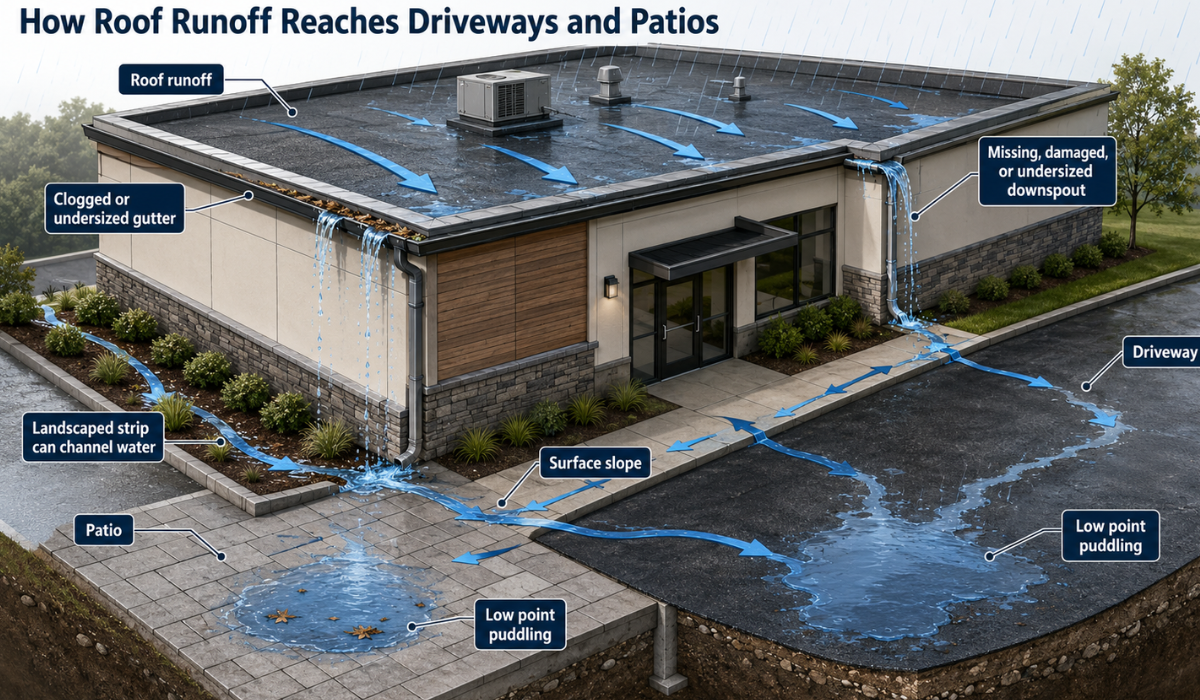
A roof sheds water toward its edges or designated drainage points.
If gutters are missing, damaged, clogged, or undersized, that runoff may fall directly onto paved or landscaped areas below.
Once the water reaches the ground, the property’s slope determines where it travels.
Water may move toward a driveway, patio, loading area, walkway, entrance, or foundation edge.
This is why the visible puddle is not always the original source of the problem.
Water collecting on a patio may have come from a roof section several feet away before following the surface grade to the low point.
A commercial drainage assessment should therefore consider both the roofline and the surrounding property.
Why Gutter Sizing Matters
Commercial gutters should be selected according to the amount of water the roof is expected to produce.
A system should not be sized only according to the length of the roof edge or the appearance of the building.
The International Plumbing Code states that horizontal roof gutters should be sized according to the flow rate from the roof surface.
Roof drainage design also considers factors such as rainfall rate, projected roof area, roof configuration, and the capacity of connected drainage components.
Important sizing considerations include:
Contributing Roof Area
The greater the roof area draining toward a gutter section, the more water that section may need to manage.
A long roof edge does not always receive water evenly. Valleys, roof slopes, adjoining roof sections, and vertical walls that direct water toward the roof can concentrate runoff in particular locations.
Local Rainfall Intensity
Gutter performance should be evaluated based on the roof size, gutter capacity, downspout placement, and expected local rainfall.
A properly sized system should manage roof runoff during heavier storms without frequent overflow.
Gutter Shape and Capacity
Gutter width, depth, shape, and slope influence how much water the system can transport.
A gutter that appears large may still overflow if it is improperly pitched or receives concentrated flow from a large roof section.
Downspout Capacity
Water cannot leave the gutters effectively when the downspouts are too small, too few, obstructed, or poorly positioned.
A system should be evaluated as a connected drainage path. Increasing gutter size without considering downspout capacity and discharge location may not correct the underlying problem.
Why Downspout Placement Is Important
Downspouts carry roof water from the gutters to the ground or another drainage system.
Their placement determines whether water is moved away effectively or simply transferred to another problem area.
A downspout that empties onto a driveway, patio, sidewalk, or low area may contribute to standing water.
Depending on the property, water may be directed to an approved storm-drain connection, underground drainage line, catch basin, landscaped area, or engineered swale.
Downspouts should not release water toward neighboring properties, busy walkways, unstable soil, or areas where it can flow back toward the building.
Gutters Are Only Part of Property Drainage
Commercial gutters manage water that comes from the roof.
They do not control all the rain that lands on a parking lot, driveway, patio, sidewalk, or surrounding landscape.
A property may continue to experience standing water even after gutter improvements when the surface drainage system is inadequate.
Property Grading
The surrounding ground should direct water away from the building and toward appropriate drainage points.
Low areas or reverse slopes can cause runoff to move back toward the structure.
Correcting these conditions may require regrading, soil work, drainage swales, or assistance from a qualified site-drainage professional.
Pavement Slope
Commercial driveways, patios, loading areas, and parking surfaces need a practical drainage route.
Settled or improperly sloped pavement can trap water even when roof runoff is controlled.
Resurfacing, drainage channels, trench drains, or catch basins may be necessary in some cases.
Storm Drains and Catch Basins
Surface drains can become blocked by leaves, sediment, trash, or damaged components.
A drain may also be too small for the area it serves. These systems should be inspected separately from the gutters when water continues to collect after storms.
Ground and Underground Drainage
Compacted soil, saturated ground, damaged drainage pipes, or poorly designed underground systems can also contribute to exterior flooding.
A gutter contractor can evaluate roof-edge drainage, but site conditions may require input from a civil engineer, drainage contractor, landscaper, or paving professional.
Signs a Commercial Gutter System Needs Attention
Visible overflow is one of the clearest signs that a gutter system is not handling water correctly.
However, other conditions may indicate that repairs, replacement, cleaning, or redesign should be considered.
Common warning signs include:
- Water spilling over gutter edges
- Gutters sagging or pulling away from the building
- Leaking seams or end caps
- Water stains beneath the roofline
- Erosion below downspouts
- Downspouts releasing water onto walkways or pavement
- Repeated puddles near entrances
- Landscaping damage below roof edges
- Debris regularly blocking the system
- Water collecting near the foundation
These symptoms do not automatically mean complete gutter replacement is necessary. Cleaning, resealing, realignment, additional downspouts, or discharge improvements may be enough in some situations.
What a Commercial Gutter Assessment Should Include
A useful assessment should examine more than the visible gutter sections.
It should identify how water moves from the roof to the final discharge area. The evaluation may include:
Roof Drainage Areas
The installer should determine which roof sections feed each gutter and whether any valleys, slopes, or adjoining surfaces concentrate water in certain locations.
Existing Gutter Condition
Gutters should be checked for corrosion, loose attachments, improper pitch, open seams, deformation, and accumulated debris.
Downspout Number and Placement
The assessment should consider whether the existing downspouts can manage the expected flow and whether their outlets release water in appropriate locations.
Surrounding Property Conditions
Driveways, patios, entrances, foundation edges, landscaped areas, and visible storm drains should be reviewed for signs of recurring water movement.
Possible Non-Gutter Problems
A responsible assessment should identify when flooding may also involve grading, pavement, surface drainage, or underground infrastructure.
This prevents the gutter system from being presented as a complete solution when additional work may be necessary.
Commercial Gutter Installation in Newnan, GA
A commercial gutter system should be designed for the building rather than installed as a one-size-fits-all product.
The appropriate system will depend on the roof layout, drainage area, rainfall design criteria, gutter capacity, downspout locations, discharge options, building materials, and surrounding property conditions.
Installation quality is also important. Gutters need secure attachment, consistent slope, sealed connections, and downspouts positioned to move water toward a suitable outlet.
Applicable building, plumbing, and stormwater requirements should be reviewed before connecting downspouts to underground drainage or public storm systems.
Request a Commercial Gutter Evaluation
Eagle Watch Roofing provides commercial gutter installation in Newnan, GA for property owners experiencing roof-edge overflow, damaged gutters, poorly placed downspouts, and other roof-drainage concerns.
The evaluation can help determine whether the existing system requires cleaning, repair, replacement, additional drainage capacity, or improved downspout placement.
When flooding appears to involve property grading, pavement slope, storm drains, or underground drainage, those conditions may need to be evaluated by an appropriate drainage professional in addition to the gutter system.
A complete assessment helps property owners understand which portion of the problem is related to roof runoff and which conditions may require separate drainage improvements.
FAQs
Can Commercial Gutters Stop a Driveway From Flooding?
Commercial gutters may reduce driveway flooding when uncontrolled roof runoff is contributing to the problem. They collect water from the roof and direct it toward a planned discharge point. Flooding caused by pavement slope, grading, blocked drains, or underground drainage problems may require additional work.
Why Does My Commercial Patio Flood When It Rains?
A patio may flood because roof water, surface runoff, or surrounding ground drains toward a low area. Missing, overflowing, or poorly placed gutters can add more water to the patio. The roof drainage system and the property’s grading should both be evaluated.
Are Commercial Gutters Different From Residential Gutters?
Commercial gutter systems may need to serve larger or more complex roof drainage areas. Their size, material, attachment method, downspout capacity, and discharge plan should be selected according to the building. The correct system depends on calculated drainage needs rather than the property classification alone.
How Is the Correct Commercial Gutter Size Determined?
Gutter sizing is based on factors such as roof drainage area, rainfall intensity, roof configuration, gutter shape, slope, and downspout capacity. The International Plumbing Code specifies that horizontal gutters should be sized according to the flow rate from the roof surface.
Can Gutters Protect a Commercial Building’s Foundation?
Gutters can reduce the amount of roof water released beside a foundation when the downspouts discharge to an appropriate location. They cannot correct existing foundation problems or poor site grading. Foundation moisture concerns should be evaluated separately when necessary.
Why Are Downspouts Important?
Downspouts provide the route through which water leaves the gutters. Too few downspouts, blocked downspouts, or outlets placed near low areas can cause overflow and pooling. Their capacity and final discharge locations should be considered during system design.
When Should Commercial Gutters Be Replaced?
Replacement may be appropriate when gutters are severely corroded, repeatedly leaking, pulling away from the building, improperly sized, or unable to maintain the correct slope. Repair may be sufficient when damage is limited. An inspection can help determine the appropriate scope.
Can New Gutters Fix Every Exterior Drainage Problem?
No, gutters only manage runoff coming from the roof. Property grading, storm drains, catch basins, pavement slope, compacted soil, and underground drainage can also cause flooding. These systems may need separate evaluation.
What Should a Commercial Gutter Service Include?
A commercial gutter service may include inspecting the roof drainage areas, measuring the existing system, checking gutter slope and attachment, evaluating downspout capacity, and reviewing visible discharge problems. The contractor should also explain when site-drainage conditions fall outside the gutter system.